

One Date, Two Stories: March 1st Between Spring and Memory
There are dates on the calendar that pass quietly, unnoticed, like ordinary pages turning. And then there are dates that carry meaning, invisible layers of memory, emotions, and tradition that depend entirely on where you stand in the world. March 1st is one of those dates.
For most of my life, March 1st meant one thing: spring. Not the official kind announced by meteorologists, but the emotional kind, the quiet certainty that winter was finally retreating. In Romania, March 1 arrives gently, wrapped in red and white threads, small smiles, and the delicate optimism that something new is about to begin.
Then I experienced March 1st in Korea.
And suddenly, the same date felt heavier. Deeper. Filled not with flowers, but with remembrance. It was the first time I understood that a single day can hold entirely different meanings depending on the stories a culture chooses to remember.

Romania: The Soft Arrival of Spring
In Romania, March 1st belongs to Mărțișor, a tradition older than memory itself, rooted in ancient seasonal rituals celebrating the end of winter. It represents a time of joy and revival of nature. In the Romanian language, the word mărțișor is derived from the word marț, the folkloric name for the month of March. The literal translation of Mărțișor would be “little March.” According to archaeological research, Mărțișor traces its history back more than 8,000 years ago. Some ethnologists believe that the Mărțișor celebration has Roman origins, while others support the theory that it is an old Daco-Thracian tradition. In ancient Rome, New Year’s Eve was celebrated on March 1 in honor of the god Mars. He was the god of war and an agricultural guardian who ensured nature’s rebirth. Therefore, the red and white colors of Mărțișor may also reference the colors of war and peace. The Dacians also celebrated the New Year on the first day of March. Ample spring celebrations were consecrated during this event.

Nowadays March 1st unfolds quietly. Romanians buy silky red and white threads (șnur) tied into a bow to which a small trinket is attached, and they offer them to their female family members, friends, and colleagues to show friendship, respect, or admiration. From March 1 to 8, when Romania celebrates not only Women’s Day but also Mother’s Day (March 8), everything revolves around these tiny gifts. But they are never just decorations. White carries the memory of winter: stillness, cold air, patience. Red carries life returning: warmth, movement, heartbeat.

Together, they symbolize transition, the fragile moment when seasons overlap, when winter has not fully left yet spring has already begun to whisper its arrival. As children, we pinned them proudly to our coats. As adults, we continue the ritual, perhaps more gently, but with the same unspoken understanding: this is a day about hope. Florists overflow with flowers. Conversations feel lighter. Even strangers seem softer somehow, as if everyone agrees ,without saying it aloud, that survival deserves celebration. March 1st in Romania does not demand reflection. It invites feeling, it tells you: Look, the world is beginning again.
Korea: When History Speaks
In Korea, March 1stcarries a different kind of awakening. Known as Samiljeol (삼일절), the day commemorates the March 1st Movement of 1919, a nationwide movement in which Koreans peacefully protested against Japanese colonial rule and declared their desire for independence. In 1910, the Japanese had annexed Korea. Fast forward to 1919, thirty-three Korean leaders publicly declared Korea’s independence and officially declared a series of peaceful demonstrations across the country, in response to the oppressive policies of their colonizer at the time. The movement quickly gained traction with over 1,500 demonstrations and approximately two million participants. That is when the Japanese authorities responded with extreme repression, resulting in numerous deaths and arrests, despite the peaceful nature of the liberating initiative. Samil Undong is considered a cornerstone of Korean independence and the modern Korean democratic struggle. It was an event that inspired and probably set in motion many others in Korea.

The atmosphere is not festive, but meaningful. Flags appear on balconies and buildings. Ceremonies are held across the country. Speeches echo words first spoken more than a century ago by people who risked everything simply to say their nation should exist freely.
Where Romanian March 1st looks toward blooming flowers, Korean March 1st looks toward courage preserved in memory. It is a day that asks people not to forget. And yet, despite its solemn tone, the day is not heavy with sadness. It carries pride, quiet, steady, enduring.
If Romania’s March 1st feels like sunrise, Korea’s March 1st feels like a candle kept burning through the night. The Same Date, Different Heartbeats
What fascinates me most is not the difference itself, but the emotional contrast. In Romania, March 1st is intimate. Personal. You wear its symbol close to your body. In Korea, March 1st is collective. Public. You see it raised in flags shared by an entire nation. One celebrates nature’s renewal. The other honors national resilience. One whispers. The other remembers aloud. And yet both are, in their own way, about beginnings.
The Bridge Hidden in Plain Sight
At first, it seems impossible to connect these traditions. What could spring charms possibly share with independence movements? But look deeper, and a quiet connection appears. Both traditions were born from endurance. Romania’s celebration grew from societies shaped by long winters, where spring meant survival, warmth returning, crops growing, life continuing. Korea’s March 1st grew from a struggle to preserve identity during colonial rule, when hope itself became an act of resistance. Different histories, same human instinct: to mark the moment when hardship begins to loosen its grip. March 1 becomes a threshold in both cultures, a symbolic doorway between what was endured and what might come next.
I often think about how symbolism takes physical form. In Romania, hope is worn, a small thread resting against your coat, moving with you through daily life. In Korea, memory is raised, flags visible to everyone, transforming private feeling into shared identity. One turns inward. The other turns outward. Yet both remind people they are connected: to nature, to history, to each other.
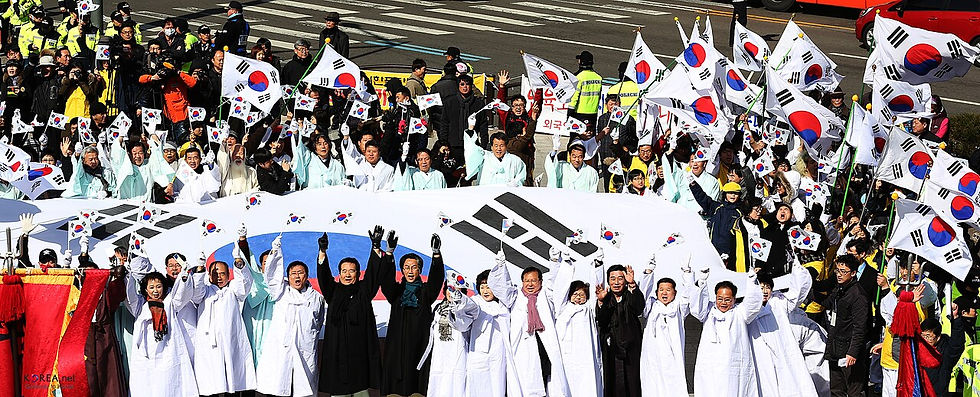
Living between cultures changes how a person experiences time. Dates stop being fixed definitions and become layered experiences. Now, when March 1st arrives, I no longer feel only spring or only remembrance. I feel both. I imagine red-and-white threads fluttering beside Korean flags, symbols born from different histories yet speaking the same quiet truth: renewal never comes without endurance. Perhaps that is why this shared date feels so meaningful. Across continents, without coordination or shared origin, two cultures chose the same day to acknowledge transformation.
And somewhere between flowers and flags lies a universal human story, the need to believe that after cold seasons, whether literal or historical, life continues.
March 1st reminds us that beginnings are rarely sudden. They grow slowly, shaped by memory, patience, and hope


Comments