

Where Death Laughs: The Colorful Truth of Romania's Merry Cemetery
In the quiet, mist-kissed hills of Maramureș County in northern Romania lies one of the world’s most surprising places: the Merry Cemetery (Cimitirul Vesel). It’s a graveyard unlike any other, not solemn, not silent, but bright, witty, and vibrantly alive in its telling of lives once lived. Here, death isn’t cloaked in mournful black but bathed in cheerful Săpânța Blue, painted oak crosses, and epic little poems that feel like friendly winks from the beyond. Walking through this open-air museum of memories is like entering a storybook , each grave a chapter, each epitaph a whisper of personality, humor, or irony that honors the deceased not just with respect, but with laughter. These crosses depict daily life scenes: shepherds with their sheep, bread baking in the kitchen, townsfolk dancing , sometimes even the comical or unexpected way someone died.

The tradition began in 1935 with a local craftsman, Stan Ioan Pătraș, whose talent lay in sculpture, paint, and poetry. He carved the first custom cross, complete with a short, rhyming epitaph that captured the essence of the person it memorialized. By the time of his death in 1977, Pătraș had handcrafted nearly 700 such crosses. His work continued today by his apprentice, turned a remote village into a cultural phenomenon. Each tombstone is painted with a signature blue-colored base, and then detailed with brightly colored lines and patterns. The epitaphs are often playful, yet the lyrical poems describe meaningful and significant aspects of people’s lives. The poems are not irreverent and do not mock the grave or its tenant, but some of them do seem somehow indiscreet, telling witty stories of infidelities, indiscretions, and a fondness for alcohol. One classic epitaph about a mother-in-law offers gentle ribbing that sparks laughter and empathy in equal measure:
Under this heavy cross
Lies my poor mother-in-law
Three more days should she have lived
I would lie, and she would read (this cross).
You, who here are passing by
Not to wake her up please try
For if she comes back home
She’ll bite my head off
But I will surely behave
So, she’ll not return from the grave.
Stay here, my dear mother-in-law!
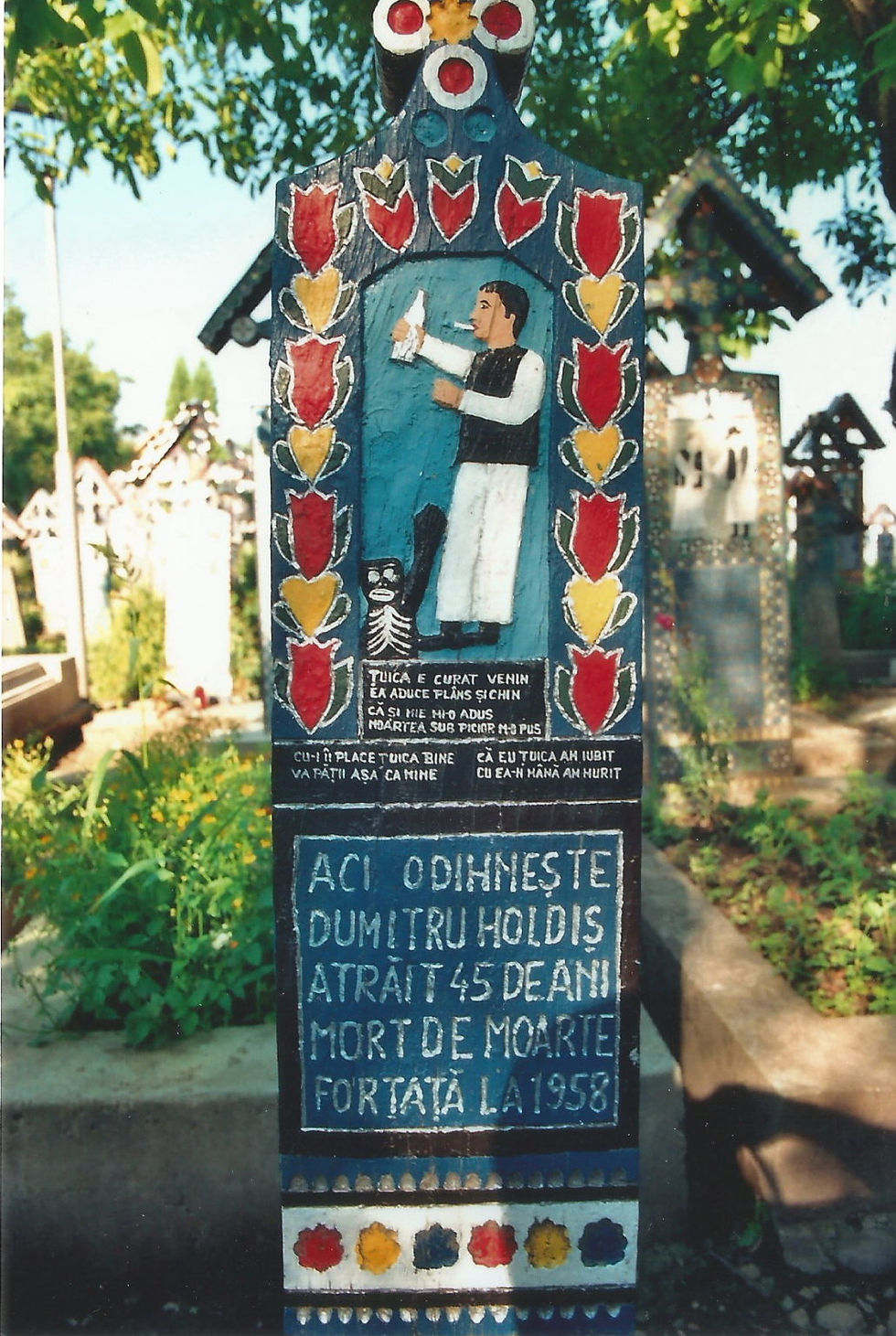
What makes Săpânța truly unique isn’t just the color or craft but the philosophy of life and death it embodies. While most European traditions treat death as a solemn ending, here it becomes a continuation, a place for storytelling and cheeky honesty. In fact, many scholars connect this outlook to ancient Dacian beliefs , local ancestors who saw death as a passage, not a halt, believing the soul lives on and rejoices in the afterlife. This attitude resonates through the poems etched into the crosses, often written in the first person and in local dialect, so it feels like the deceased themselves decided not to go quietly into that good night.

A Cultural Bridge: Romanian and Korean Views of Death
At first glance, a cheerful cemetery and Korean funeral traditions may seem worlds apart, and in many ways they are. Korean funerals are rooted in deep respect for ancestors, influenced by Confucianism, Buddhism, and indigenous beliefs, focusing on family rites and honoring the transition of a soul with ritual, food offerings, and reverence.
In Korea, death is solemn and deeply family-oriented, with rituals like Jesa(제사)
, annual ancestral rites that keep connection alive between the living and the deceased, reflecting a belief that the departed continue to influence and guide those still here.
Yet, despite these differences in ceremony and expression, there’s a surprising emotional parallel between Săpânța and Korean culture:
Celebration of life, not just mourning: In both places, sadness may be present, but so is a recognition that death is part of life’s cycle. In Korea, funerals aren’t always grim; families and friends often stay together for days, sharing meals, stories, and even light moments as part of communal mourning, a social act of support that goes beyond sorrow.
Storytelling as remembrance: Săpânța’s poetic epitaphs tell vivid, personal stories. In Korean tradition, while not poetic on headstones, family and community members recount life stories during ceremonies and annual rites, honoring memories through narrative and shared recollection.
Mourning as community practice: Both cultures involve the community deeply, in Romania through the universal humor and accessibility of the cemetery’s tales; in Korea through communal gatherings, shared meals, and collective ritual.
So while the tone differs, Romanian joviality meeting Korean reverence, both reflect a universal truth: when we lose someone, we don’t just mourn them , we remember and reclaim them through stories, shared emotion, and ritual. That’s a bridge worth noticing.

Visiting the Merry Cemetery feels like stepping into a place where life refuses to be reduced to silence. Every cross, color, and couplet invites you to laugh, think, and connect, not just with the people of Săpânța, but with your own views on life, memory, and joy. It’s a once-in-a-lifetime experience that challenges how you think about death and reminds you that the best memorials celebrate personality, history, and heart.
If you love travel that transforms you, that nudges you to feel more deeply about what it means to live and let go, the Merry Cemetery isn’t just a destination. It’s a conversation with humanity itself. And I promise, you’ll walk away smiling.


Comments