

Deoksugung Palace: The Fusion of Traditional and Western Styles


Palaces aren’t just emblems of history. They stand tall and prideful as miracles of human architecture genius. It feels amazing when you walk through the same paths as the ancestors: taking in a parchment of their past with you as you learn more about it. Let’s talk more about the glorious palaces of Korea!
Wandering in the Footsteps of History

Deoksugung Palace was originally not a royal residence but the home of Grand Prince Wolsan (1454-1488), the elder brother of King Seongjong (1469-1494) of the Joseon dynasty. It was only in 1593 that the site served as a temporary palace for the royal family after their main residence was destroyed during the Imjin War. King Seonjo also stayed at Deoksugung following his return to the city. The palace officially became a proper royal residence when Gwanghaegun (1575-1641) ascended to the throne and named it Gyeongungung Palace in 1611. In the subsequent decades, it shifted between being an official palace and a temporary residence. The name "Deoksugung", meaning "palace of virtuous longevity", was not officially adopted until 1907. Although the palace once covered a vast area with many buildings, today’s grounds are much smaller, with only a few structures remaining of its former grandeur.
The palace features several historically significant structures.

Firstly, Seokjojeon Hall, known as the "hall made of stone," a Neo-Classical building with Greek-inspired columns and decorative motifs like acanthus leaves and flowering fruit trees, symbolizing Korea’s imperial family. Originally Emperor Gojong’s office and residence, it was renovated in 2014 and now houses the Deoksugung National Museum. Its surrounding garden combines Western and Eastern styles, reflecting Seoul's historical development.

Secondly, there stands the Junghwajeon Hall which served as the main hall of Deoksugung Palace, where King Gojong conducted official ceremonies and received his subjects as well as foreign envoys.

The primary entrance to Junghwajeon was the Junghwamun Gate. Both the hall and the gate, built in 1902, were destroyed by fire in 1904 and reconstructed in 1906, during the 43rd year of King Gojong's reign. Additionally, it was a venue for ceremonies such as coronations. The name ‘Junghwajeon’ also served as a prayer for the Korean Empire to preserve its independence and peace amid the assaults from the Great Powers.
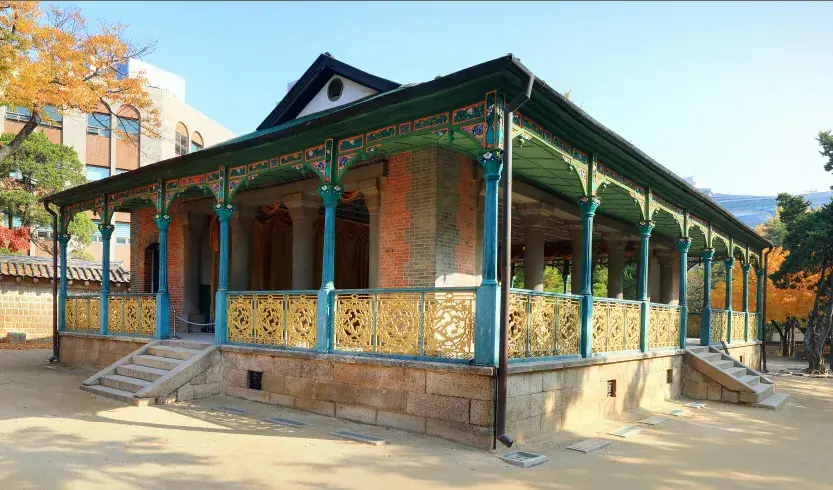
Jeonggwanheon Pavilion must also be mentioned among the palace’s attractions. Its name translates to "silent gaze." This pavilion served as a temporary site for enshrining the royal portraits of Joseon dynasty kings. It is a fascinating blend of Eastern and Western architectural styles. Its foundation features Romanesque-style artificial stone pillars that define the interior space, while an external porch with pillars extends to the east, south, and west. The porch’s railing is decorated with traditional symbols and patterns, including deer, pine trees, arabesques, and bats.
Other notable buildings of this palace are: the principle gate named Daehanmun, Deokhongjeon Hall, Junghwajeon Hall with the Junghwamun Gate, Jeukjodang Hall and Junmyeongdang Hall, Seogeodang Hall, Dondeokjon Hall, and Jungmyeongjeon Hall.
Things to do and to know when visiting Deoksugung Palace
One of the interesting activities at the Deoksugung Palace is the Changing of the Guard. This ceremony occurs in front of Daehanmun Gate. Just like for other palaces, this event marks the shift changes of the guards stationed at the royal palace gates offering a glimpse of regal uniforms and weapons, accompanied by the sounds of traditional instruments.

Another good idea is to book for a tour of the exhibition floor in the Daehan Empire History Museum. This is another free tour, but a booking is required and space is limited. You’ll need to add your name to the waiting list at the museum entrance. The english tour starts at 11:50 or 14:50 and only foreigners are allowed.

Deoksugung palace is known to be the only palace in Seoul that features an art museum. Within the complex, there is a branch of the Korean Modern and Contemporary Art Museum. However, to enjoy what it offers, an extra admission fee is required as it is not included in the palace entrance fee. The museum’s schedule follows: from 10:00 to 18:00 on Tuesday, Thursday, Friday, and Sunday, and from 10:00 to 21:00 on Wednesday and Saturday.
General admission is available from 09:00 to 21:00, with the last entry permitted at 20:00. The exhibition hours are as follows: Seokjojeon Hall is open from 09:30 to 17:30, Dondeokjeon Hall is accessible from 09:00 to 17:30, with the last admissions at 17:00; and Jungmyeongjeon Hall is open from 09:30 to 17:30, with the final admissions at 17:00.
If you're interested in gaining insights from a knowledgeable local guide, you have the opportunity to participate in one of the free 60-minute guided tours that are offered in various languages throughout the day. These tours provide a great way to learn more about the site and its history, and they are scheduled at different times to accommodate visitors' schedules. The guided tours in Chinese are available at 10:00 in the morning and again at 14:30 in the afternoon. If you prefer English, the tours are held at 10:30 and 13:30. For Japanese speakers, the tours are available at 9:30 in the morning and at 16:30 in the late afternoon.
The admission fees are 1,000 won for individuals and 800 won for groups of 10 or more people. Please note that a separate ticket must be purchased for entry to the art museum.
The palace is located at 99 Sejong-daero, Jung-gu in Seoul and is conveniently accessible from City Hall Station. All you have to do is take Line 1 and exit at Exit 2, or transfer to Line 2 and exit at Exit 12.
Deoksugung Palace stands as a captivating testament to Korea’s rich cultural heritage and historical resilience. Its unique blend of traditional Korean and Western architectural styles, along with its tranquil gardens and historic significance, makes it a must-visit destination for anyone interested in Korea’s past.


Comments