

Gyeongbokgung Palace: From Royal Residence to Cultural Landmark


To me, a palace is more than just a sublime historical monument; it is the bridge that connects me to the past of a nation, the emblem of royalty and leadership. The palace, though empty, tells stories of generations gone by.
It stands as a silent witness to history, its walls echoing with the memories of those who once walked through its halls. Each stone and corridor reflects the dreams, struggles, and triumphs of the people it has sheltered, reminding us of our roots and inspiring us to carry their legacy forward.
The pride of being Korean is deeply intertwined with the country's rich history and majestic palaces that dot the urban landscape. They embody the elegance, artistry, and strength of Korea’s past, serving as a reminder of the ingenuity and spirit of the Korean people.
Let’s walk through these grand structures and discover more about them as we explore further!
Architectural Wonders of Gyeongbokgung Palace: A Journey Through Its Buildings

Gyeongbokgung Palace, built in 1394, is the largest and primary palace of the Joseon Dynasty in Seoul. Known as the "Palace Creatively Blessed by Heaven," Gyeongbokgung Palace served as the royal heart of Seoul. The palace continued to grow during the rule of King Taejong and King Sejong the Great. Then, it was destroyed during the 1592 Imjin War, abandoned for 270 years, and rebuilt in the 1860s. Despite Japan's systematic destruction in the early 20th century, ongoing restoration since the 1990s has returned it to its former grandeur.
Gyeongbokgung Palace is thought to be situated on Seoul’s most fortunate site, overlooking Namsan Mountain and Cheonggyecheon Stream, with Bugaksan Mountain in the background. The palace represents the founding of the Joseon Dynasty and features magnificent, timeless beauty.

The Chinese characters for “Gyeongbok (景福)” translate to “great fortune,” with each character carrying its own significance. The first character, “景” (Gyeong), means “scenery” or “prosperity,” symbolizing brightness, beauty, and a flourishing state. The second character, “福” (bok), represents “blessing” or “good fortune,” signifying happiness, prosperity, and auspiciousness. Together, the name embodies hope or wish for a future filled with prosperity, happiness, and abundant blessings, reflecting the aspirations of the founding period of the Joseon Dynasty.
In 1997, Changdeokgung Palace was inscribed on the UNESCO World Cultural Heritage list for its remarkable harmony with the land and natural surroundings.
Taking a Look at the Iconic Halls and Gates of Gyeongbokgung Palace
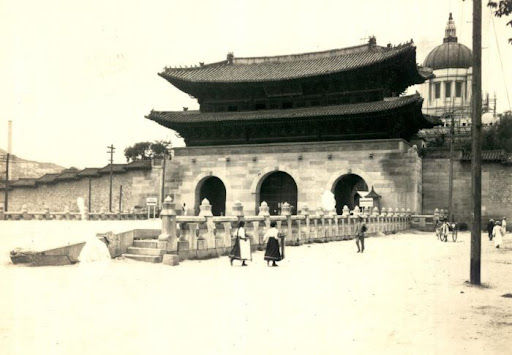
The main gate of Gyeongbokgung Palace, Gwanghwamun (광화문), or the southern gate, is the majestic gateway to the royal complex. Built in 1395 during the Joseon Dynasty and restored in 2010 features traditional architecture and statues of King Sejong and Admiral Yi Sun-sin. It has witnessed many historic events and now serves as a popular cultural site, connecting visitors to Korea’s rich history and heritage. Its architectural design reflects traditional Joseon-era aesthetics, featuring a majestic wooden structure, multiple tiled roofs, and intricate dancheong decorative patterns.

Over the centuries, Gwanghwamun witnessed numerous historic moments, including royal processions, state ceremonies, and diplomatic events. The gate suffered damage during the Japanese occupation, when it was dismantled and neglected. However, in recent decades, the gate was meticulously restored, symbolizing Korea’s cultural revival and resilience. Today, Gyeonghwamun stands as a powerful emblem of Korea’s historical legacy and ongoing efforts to preserve its cultural heritage.

Heungnyemun (흥례문), also known as the second inner gate of Gyeongbokgung, served as an important entrance to the palace. Historically, gatekeepers worked in two-hour shifts to monitor this gate. Today, it hosts the changing of the guard ceremonies, which are performed according to the procedures outlined in the book ‘Uigwe’, a record of Joseon’s state ceremonies. This book is part of UNESCO’s Memory of the World programme.

Heungnyemun, often seen as the face of the dynasty, was challenged many times throughout history. During the 19th century, as imperialism spread worldwide, when Korea was colonized by Japan, the Japanese dismantled the original second gate and replaced it with the Government-General building, aiming to obstruct Koreans’ view of Gyeongbokgung, a symbol of their nation.
Korean people tirelessly fought for independence. Their efforts led to Korea’s liberation in 1945 and the foundation of the Republic of Korea. The Government-General building was later used as a museum. In 1995, the Korean government tore down the building, and part of it was preserved at Independence Hall. The second gate was reconstructed in its original location. While it is not an exact replica of the gate from the Joseon era, today it stands as a powerful symbol of Koreans’ renewed pride and their desire to reconnect with their national heritage.
Two corridors extend from this gate, creating an enclosed area. At the center of this enclosure lies Geumcheon Stream, which was designed to flow through the Palace from west to east, descending from Mt. Baegak.

Geonchunmun Gate (건춘문), also known as the Eastern Gate, was originally constructed when Gyeongbokgung Palace was founded in 1395, during the 4th year of King Taejo’s reign. It was rebuilt in May 1428, in the 10th year of King Sejong’s reign. The structure was burned down during the Imjin War in 1592, the 25th year of King Seonjo’s reign, and remained abandoned for approximately 270 years. It was reconstructed again in 1865, in the 2nd year of King Gojong’s reign, and has been preserved to this day. It was restored in modern times to preserve its traditional wooden architecture and tiled roof.

Historically. it served as a functional and ceremonial passage within Gyeongbokgung Palace, symbolizing the palace's intricate design and regal authority while facilitating movement and access across its grounds. It was primarily used by members of the royal family and courtiers.

Yeongchumun (영춘문), or "Welcoming Autumn Gate," is the western entrance of Gyeongbokgung Palace in Seoul. Built in 1426 under King Sejong. Destroyed during the Japanese invasions in 1592, it was rebuilt around 1867, damaged again in the 1920s, and restored in 1975. After being closed for decades, it reopened in 2018 and now symbolizes Joseon’s royal traditions, with recent efforts ensuring its preservation after 2023 vandalism.

Yeongchumun was mainly for officials and bureaucrats, marking it as an administrative entrance. Its placement aligned with feng shui principles, balancing natural features like Bukhansan Mountain to the north and surrounding waters to the south, symbolizing harmony and stability.

Geunjeongjeon was damaged during the Japanese invasions in the late 16th century and was later restored. Many parts of Gyeongbokgung, including Geunjeongjeon, were damaged during the Japanese colonial period and the Korean War. Restoration efforts have been ongoing since the late 20th century. Geunjeongjeon was damaged during the Japanese invasions in the late 16th century and was later restored.Many parts of Gyeongbokgung, including Geunjeongjeon, were damaged during the Japanese colonial period and the Korean War. Restoration efforts have been ongoing since the late 20th century. Today, Geunjeongjeon has been faithfully reconstructed and is one of the most visited and celebrated structures within Gyeongbokgung Palace. It is designated as a National Treasure of South Korea.

At the heart of the palace lies Geunjeongjeon Hall (근정전), the primary throne hall where the king held court and conducted official ceremonies. Built on an elevated stone platform, this structure showcases exquisite wooden beams, intricate decorative details, and a sweeping tiled roof. It was here that royal edicts were announced, and important state affairs were managed. Geunjeongjeon Hall was the central venue for royal coronations, official audiences, state banquets, diplomatic receptions, and the announcement of important decrees, playing an important role - serving as a vital ceremonial entrance and exit point for officials and courtiers during important court events and processions that facilitated grand official ceremonies and the daily functions of the royal court.

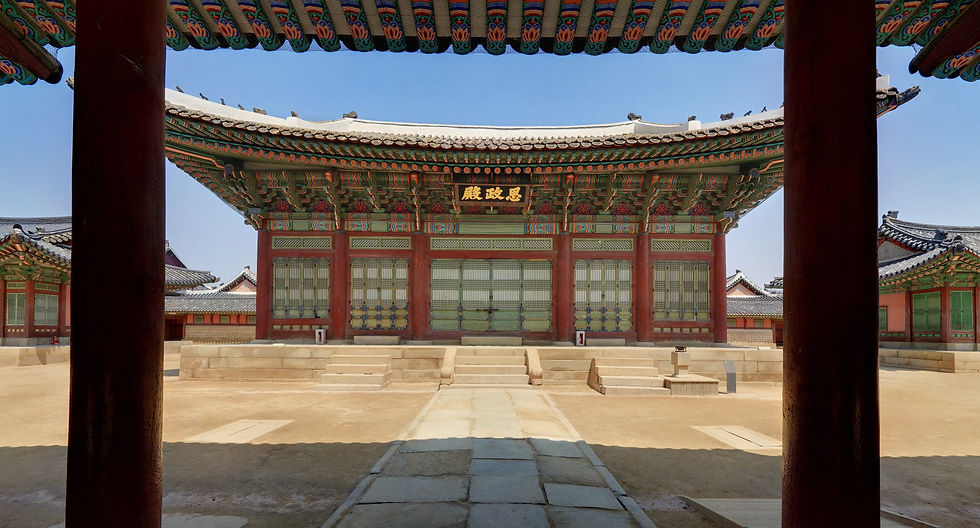
Sajeongjeon Hall (사정전),originally constructed in 1395 alongside Gyeongbokgung Palace and was rebuilt after it was destroyed by fire in 1553, functioned as the king's primary office for overseeing state matters. Daily morning assemblies with senior officials were held here, and the space features a setup reminiscent of a throne room. It was a place where the king could conduct administrative work and engage in discussions related to governance. As one of the most important buildings in Gyeongbokgung Palace, Sajeongjeon played a vital role in the political and administrative life of the Joseon Dynasty.
The second structure also burned down when the entire palace was consumed by flames during the seven-year war following the Japanese invasion of Korea in 1592. The current building was constructed in 1867 during a major renovation of the palace, which included restoring key structures such as Geunjeongjeon Hall, Gyeonghoeru Pavilion, and Sujeongjeon Hall. The name "Sajeongjeon" on the plaque was inscribed by Jo Seok-u, then Minister of Personnel, during this renovation. As one of the two most significant buildings in Gyeongbokgung, alongside the throne hall Geunjeongjeon, Sajeongjeon was a central space where many Joseon rulers conducted their work and leisure. Since its reconstruction in 1867, the hall has remained largely unchanged and is considered an important example of the architectural style and layout of Joseon Dynasty palace buildings.

Additionally, one of the buildings served as a library for the kings, where they studied Chinese classics and consulted with scholars on how to govern justly. We won't spend too much time in this area, or else we'll never complete our tour.
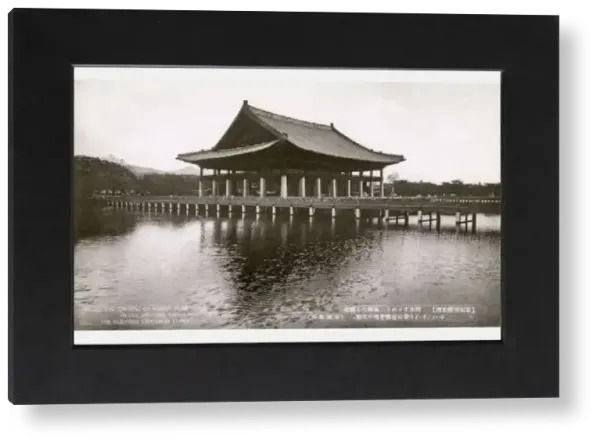
One of the most picturesque structures in Gyeongbokgung is Gyeonghoeru Pavilion, situated on a large pond within the palace grounds. Used for royal banquets, celebrations, and diplomatic receptions, the pavilion’s open design offers breathtaking views of the surrounding gardens and water. Its elegant wooden construction and scenic setting make it a symbol of Korea’s traditional aesthetic.
Gyeonghoeru covers an area of approximately 1,353 square meters and is supported by 48 stone pillars, giving it a majestic and open appearance. The pavilion's open sides allow for panoramic views of the surrounding landscape and the palace grounds, making it a perfect location for hosting royal events and gatherings.
Royals and distinguished guests would also enjoy boating on the pond. In 1997, a cleanup project of the pond uncovered two bronze dragon sculptures buried in the mud at the bottom. Each dragon weighed approximately 66.5 kg and stood about 1 meter tall. It was believed that these dragons symbolized control over water and rainfall. They were intentionally placed in the pond to safeguard the wooden structures from fire, while also hoping for rain to ensure a bountiful harvest.
Throughout its history, Gyeonghoeru has undergone several restorations, especially after being damaged during invasions and wars. Today, it stands as a symbol of Korea’s royal heritage and architectural ingenuity, offering visitors a glimpse into the grandeur of the Joseon Dynasty's court life.
To explore the pavilion's floor, visitors must join a small guided group led by a certified Cultural Heritage Interpreter to preserve the delicate architecture, with advance reservations required—up to 7 days before, limited to 30 Koreans and 10 foreigners per session, which lasts about 40 minutes, scheduled at 10 a.m., 2 p.m., and 4 p.m. (additional on weekends), with tours only in Korean, and participants must bring confirmation and arrive 5 minutes early at Hamheung Gate after purchasing a general Gyeongbokgung Palace ticket online in advance.

Then, it follows Hyangwonjeong Pavilion which is a smaller, charming structure associated with leisure and tranquility. Its picturesque setting and tranquil ambiance made it a favored spot for royal relaxation and reflection, embodying the harmony between architecture and nature in Korean culture.

Gyeongbokgung Palace’s gates and halls embody Korea’s historical spirit. They continue to attract visitors and remind us of the nation’s rich cultural roots.
Hands-On Ways to Step Back in Time and Embrace Traditions and History
Within the palace grounds, visitors can indulge in traditional Korean performances, such as enchanting music, mesmerizing dance, and captivating theater. The cultural shows are a wonderful way to experience the country's vibrant traditions and artistic expressions and provide a glimpse into the country's rich cultural heritage. From the intricate details of traditional Korean music and dance to the dramatic storylines of traditional Korean theater, visitors are sure to be captivated by the beauty and energy of these performances.
The National Folk Museum is a must-visit destination for anyone interested in learning about Korean culture. With its vast collection of artifacts and interactive exhibitions, visitors can gain a deeper understanding of the country's rich cultural heritage and significance in modern Korean society. Visitors could add on their sightseeing list the National Palace of Museum too. This museum enables them to see how the royal family has lived.


Another unique ways to enjoy the palace is by wearing a Hanbok, which is a traditional Korean attire. If you do so, admission is free, and many tourists rent Hanboks to capture memorable photos against the scenic backdrop of the palace. For those paying the standard adult entrance fee, it’s only 3,000 KRW, with various discounts and ticket options available, more details can be found below.

Also, make sure to catch the daily changing of the guards ceremony at the main Gwanghwamun Gate, a captivating event that showcases Korea’s rich tradition and history. This impressive 20-minute ceremony occurs twice a day, at 10 a.m. and 2 p.m., and features soldiers dressed in traditional uniforms performing precise and ceremonial movements.
What's special about this event is the historical context that comes with it. The changing of the guards ceremony at Gyeongbokgung Palace is a centuries-old tradition that dates back to the Joseon Dynasty. It was originally performed to ensure the security of the royal palace and to demonstrate the authority and discipline of the royal guards. Today, the ceremony is a reenactment designed to showcase Korea’s rich cultural heritage and historical customs.
During the event, a team of guards dressed in traditional Joseon-era uniforms, complete with colorful robes, helmets, and weapons, performs a highly synchronized routine. They march in unison, perform ceremonial drills, and carry out a formal handover of duties, all set against the backdrop of the grand Gwanghwamun Gate.

The event is not only a visual spectacle but also an educational experience, offering insight into Korea’s royal history and military traditions. Visitors can observe the detailed rituals and the precise movements of the guards, which have been preserved and performed for generations. The ceremony provides a lively, immersive glimpse into Korea’s past, making it a must-see part of any visit to Gyeongbokgung Palace.
Watching the guards change shifts is a vivid experience, offering a glimpse into Korea’s cultural heritage and adding a memorable highlight to your visit. Arriving a little early is recommended to secure a good viewing spot and fully enjoy this colorful and meaningful spectacle.
What to Expect: Key Details Before Arriving at the Palace
The palace is closed on Tuesdays, so plan your visit accordingly. The hours of admission vary depending on the season, so it's a good idea to check the specific timings before you go.
While the palace is beautiful to visit at any time of the year, springtime is especially stunning due to the blooming flowers and cherry blossom trees that surround the area. It creates a picturesque setting that’s perfect for photos and sightseeing.
Additionally, free guided tours in multiple foreign languages are offered, allowing visitors from around the world to learn more about the history and significance of the site. If you prefer to explore independently, it’s highly recommended to rent an audio guide. This way, you can learn interesting facts and details about the palace and its features while wandering through the grounds at your own pace.
Occasionally, they organize special night tours of the palace, which are available only to a limited number of visitors each time. These evening excursions provide a unique opportunity to experience the beauty and ambiance of the palace after sunset, offering a different perspective and a more tranquil atmosphere. Because the number of participants is capped, it’s advisable to reserve your spot well in advance if you’re interested in attending, as these tours tend to be quite popular and fill up quickly.
Complimentary guided tours are available in the following foreign languages with the purchase of your entrance ticket: English, Japanese, Chinese, Vietnamese, Indonesian, and Spanish, offering an accessible and enriching experience for all visitors.
The standard admission fee for an individual adult is 3,000 KRW, while minors aged 18 and under, seniors aged 65 and older, and anyone wearing traditional Hanbok are all granted free entry, making it accessible for a wide range of visitors and encouraging the experience of cultural heritage regardless of age or attire.
Gyeongbokgung is situated in the northern part of Seoul and can be easily reached by subway. The closest station is Gyeongbokgung Station (경복궁역) on Line 3. When you exit through Exit 5, you'll find yourself right in front of the main entrance, the Gwanghwamun Gate. Alternatively, you can also take Line 5 to Gwanghwamun Station (광화문역). From Exit 2 there, it’s just a 7-minute walk to the palace.
The palace stands as a testament to the rich history and remarkable architecture of its era. Visiting this historic site provides a unique opportunity to connect with the past and appreciate the cultural heritage it embodies. It is truly a place that leaves a lasting impression and encourages further exploration and reflection.
The palace stands as a testament to the rich history and remarkable architecture of its era. Visiting this historic site provides a unique opportunity to connect with the past and appreciate the cultural heritage it embodies. It is truly a place that leaves a lasting impression and encourages further exploration and reflection.


Comments