

Changdeokgung Palace: Wander Through the Charming Changdeokgung Palace


Further exploring the history behind the Korean palaces, we find ourselves deepened in the past of how Korea once looked like. Knowledge about its past and culture is handy to every tourist that steps into the beauty of the country.
Historical facts about the palace

Changdeokgung Palace, or Donggwol (The East Palace) was built as the second royal villa after Gyeongbokgung Palace in 1405. Serving as the main residence for many Joseon dynasty kings s the best-preserved of the five remaining royal palaces from that era. King Tejong’s detached palace, constructed as a retreat away from Gyeongbokgung, was completed in 1434, shortly after the capital's relocation to Hanyang. During its construction, the king often held government affairs there, and its completion marked a time of celebration for the people, symbolizing renewal and a new beginning.
The key buildings within the palace include: the palace’s main gate Donghwamun which is known as one of the oldest principal gates among all palaces, Seonjeongjeon Hall was the place where kings held court and conversed with their subjects about state affairs, and the Injeongjeon Hall, which served as the throne hall during the Joseon Dynasty where major state events were held. Furthermore, the palace complex features the Huijeongdang, the chief council hall where royal advisors gathered, and numerous pavilions and gardens that exemplify traditional Korean architecture.

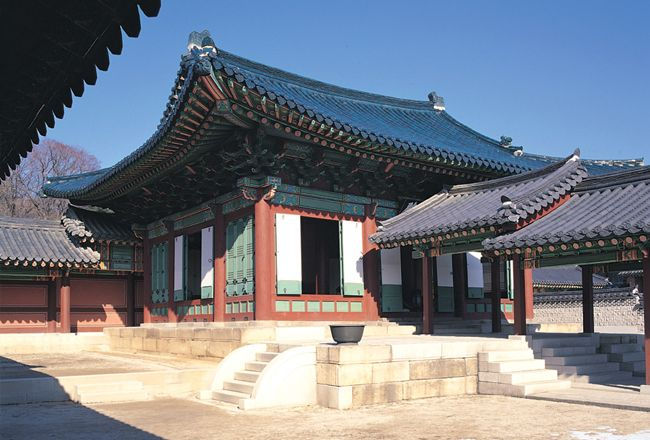


The palace complex also consists of a royal family residence, and a rear garden.
Walking In the Garden of Royal Serenity

Huwon, the Rear Garden, found in the northern quarters of the palace, has a remarkable traditional Korean landscape design. Built in 1406, its structures are subtly woven into the natural terrain creating a serene forest-like environment with minimal artificial intervention.
In the past, it served as a retreat for kings and royal family members being set in the most remote northern part of the palace. Besides spending leisure time, the garden also hosted important events like state exams, banquets, and even hunting activities.
Covering about 60% of the entire palace grounds, an expansive 434,877 square meters, Huwon features beautiful ponds such as Buyongji, Aeryeonji, and Jondeokji, complemented by pavilions like Buyongjeong, Jondeokjeong, and Gwanramjeong. These elements were developed over centuries, blending seamlessly with the natural landscape. The garden’s pure, organic beauty remains unmatched by other palaces worldwide.

Found at 99, Yulgok-ro, Jongno-gu, Seoul, the Secret Garden is open from March to June and September to October, with visiting hours from 10:00 AM to 5:30 PM, and last admission at 4:00 PM; during July and August, it operates from 10:00 AM to 5:10 PM, with the last admission at 4:00 PM; in November, it is open from 10:00 AM to 5:00 PM, with the last admission at 3:30 PM; and from December to February, the hours are from 10:00 AM to 4:10 PM, with the last admission at 3:00 PM.
Tours can be provided from March to November in English at 10:30, 11:30, 14:30, and 15:30, while from December to February with tours in English at 10:30, 11:30, 14:30. In Japanese, during January-December period of time, on Wednesdays, Fridays, and Sundays at 13:30. Lastly, in Chinese, around January and December, tours can be set on Tuesdays, Thursdays, and Saturdays at 12:30.
Purchasing a ticket for The Secret Garden requires prior to purchase of a general admission ticket. Access to The Secret Garden is limited to 100 visitors per session, 50 through online reservations and 50 on-site, available on a first-come, first-served basis. Please contact the Ticket Reservation website for more detailed information.
More facts a visitor should know when entering the palace
The palace welcomes tourists around February to May and September to October, from 09:00 in the morning until 18:00 in the evening; during June to August, the hours extend from 09:00 to 18:30; and from November to January, the hours are from 09:00 to 17:30. Please note that the last admission is allowed one hour before closing time. If a public holiday occurs on a Monday, the facility will be closed on the next business day instead.
The entrance fee for the Palace Site is ₩3,000 won, while visiting the Secret Garden costs 5,000 won for adults and 2,500 won for children. Please refer to the official website for more detailed information. Meanwhile, the admission fees at its magnificent garden vary. For adults aged 19 and over is ₩5,000 plus a general admission fee of ₩3,000, the sum being a total of ₩8,000; for seniors aged 65 and over, the fee is ₩5,000 with no additional general admission fee, totaling ₩5,000; and for youth aged 7 to 18, the fee is ₩2,500 with no additional general admission fee, totaling ₩2,500. Arriving late will result in no entry and no refunds.
Pro tip, you can get yourself the Royal Palace Pass which is a package ticket costing 6,000 Korean Won that grants access to four palaces: Gyeongbokgung Palace, Changdeokgung Palace (excluding the Secret Garden), Changgyeonggung Palace, and Deoksugung Palace, as well as Jongmyo Shrine; it can be purchased at the ticket office located at any of these four palaces or at Jongmyo Shrine, and the pass remains valid for six months from the date of purchase.
Free guided tours availability varies by location, language, and season: at the Palace Building Area from January to December, guided and self-guided tours are available in English at 10:15 and 13:15 daily; in Japanese on Wednesdays, Fridays, and Sundays at 11:00; in Chinese on Tuesdays, Thursdays, and Saturdays at 10:00; with tours starting at the main information board.
To get to the Changdeokgung Palace you have to take the subway and exit at Anguk Station (Line 3, Exit 3). Then walk for 5 minutes until you reach the entrance. Or you can exit Jongno 3-ga Station (Lines 1, 3, 5, Exit 7) and walk for 10 minutes, depending on the direction you come from.
Changdeokgung Palace now represents a treasured symbol of Seoul’s rich history and exquisite architecture. It is a wonderful place that needs to be checked out with an open heart and love for history.


Comments